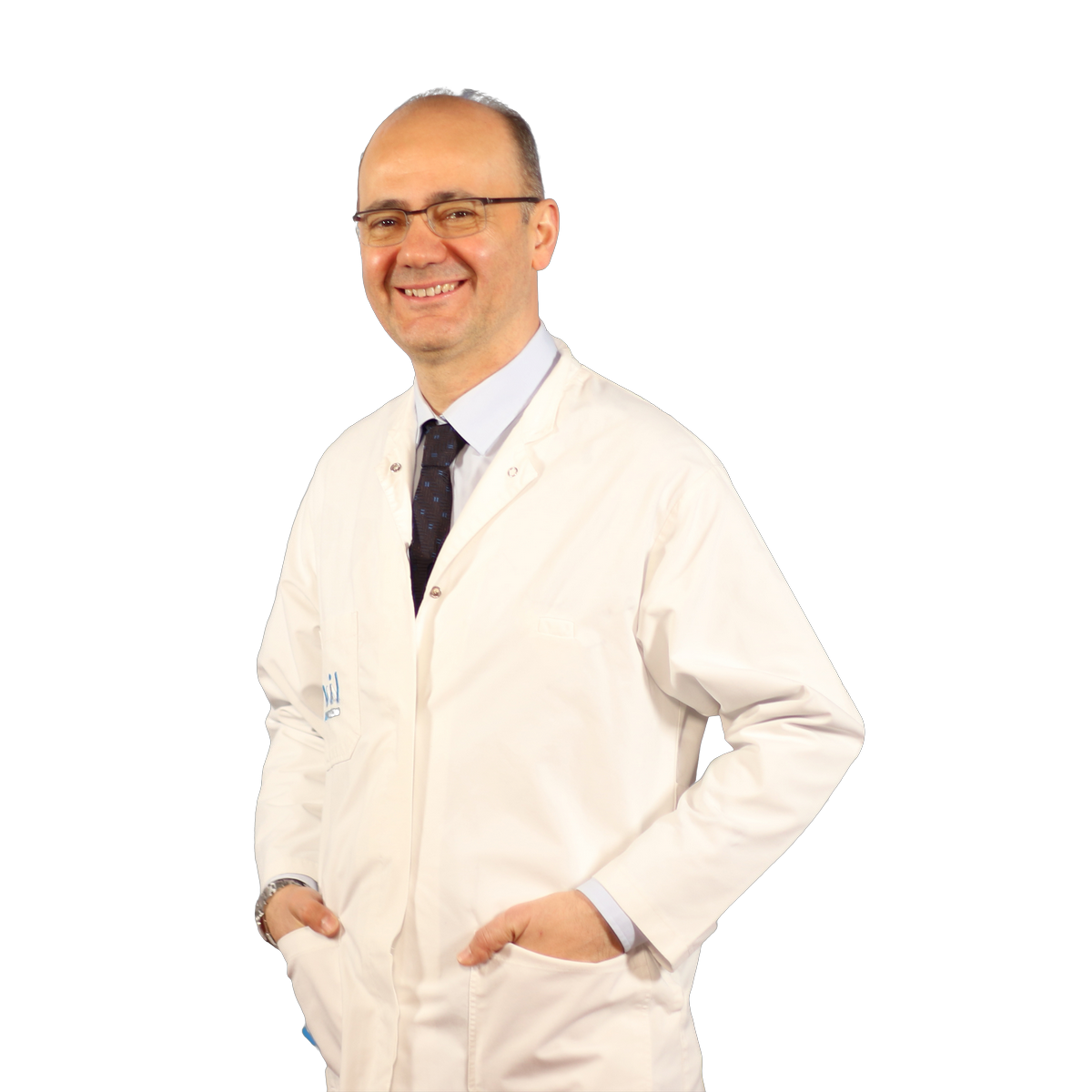
İstanbul Üniversitesi İstanbul Tıp Fakültesi Genel Cerrahi Anabilim Dalı
İstanbul Üniversitesi İstanbul Tıp Fakültesi Genel Cerrahi Anabilim Dalı
Gastric cancer treated with laparoscopic gastrectomy, D2 lymphadenectomy, perioperative chemotherapy and HIPEC for selected peritoneal disease.
Gastric cancer (stomach cancer) is a malignant neoplasm arising predominantly from the glandular epithelium of the stomach. Adenocarcinoma accounts for more than 90% of cases. It is the fifth most common cancer globally and the fourth leading cause of cancer mortality, with the highest incidence in East Asia, Eastern Europe, and parts of South America.
Gastric cancers are anatomically classified by location (cardia, body, antrum/pylorus) and histologically by Lauren classification (intestinal vs. diffuse type). Molecularly, four subtypes are recognized by TCGA: EBV-positive, MSI, genomically stable (GS), and chromosomally unstable (CIN) — each with distinct prognostic and therapeutic implications.
📌 Key fact: Five-year survival exceeds 70% when gastric cancer is detected at Stage I. Eradication of H. pylori infection is the most effective preventive measure for intestinal-type gastric cancer.
Dysphagia, hematemesis, involuntary weight loss exceeding 10% of body weight, a palpable epigastric mass, or new-onset dyspepsia in a patient over 55 years of age require urgent upper GI endoscopy to exclude gastric malignancy.
Upper gastrointestinal endoscopy with multiple biopsies is the diagnostic standard. Staging workup includes CT of the chest, abdomen and pelvis; endoscopic ultrasound (EUS) for T and N staging; diagnostic laparoscopy to exclude peritoneal metastases before planned curative resection; and molecular profiling (HER2, PD-L1, MSI/MMR) to guide systemic therapy.
Survival data are approximate population-based estimates. Individual prognosis depends on tumor biology, molecular subtype, surgical quality, and access to multidisciplinary oncological care.
Gastric cancer treatment requires multidisciplinary oncology board review. The integration of surgery, perioperative chemotherapy, and — in selected patients — targeted therapy or immunotherapy has substantially improved outcomes over the past decade.
Laparoscopic gastrectomy — either subtotal (distal) for antral tumors or total for body and proximal lesions — removes the tumor-bearing stomach with adequate margins and systematic D2 lymphadenectomy. D2 dissection, removing perigastric and hepatic/splenic artery nodes, is the oncological standard associated with the best long-term survival.
Randomized trials confirm that laparoscopic gastrectomy achieves equivalent oncological outcomes to open surgery while offering significantly less postoperative pain, shorter hospital stay (5–7 days), reduced blood loss, and faster recovery. Prof. Dr. Hakan Yanar performs both subtotal and total gastrectomy laparoscopically.
The FLOT4 trial established perioperative FLOT (docetaxel, oxaliplatin, leucovorin, 5-FU) as the current standard of care for resectable locally advanced gastric and gastroesophageal junction cancers. Four cycles are administered before and four after surgery, improving R0 resection rates and overall survival compared with epirubicin-based regimens.
For HER2-positive tumors, trastuzumab is added to platinum-based chemotherapy in the palliative setting (ToGA trial). MSI-H/dMMR tumors show exceptional responses to immune checkpoint inhibitors (pembrolizumab, nivolumab).
In carefully selected patients with limited peritoneal metastases from gastric cancer or positive peritoneal cytology, cytoreductive surgery combined with HIPEC may be offered with curative or cytoreductive intent. Selection criteria include complete cytoreduction (CC-0/1 score), good performance status, and absence of extra-abdominal disease.
Prof. Dr. Hakan Yanar is HIPEC-certified and performs the procedure at Liv Hospital Ulus. Each candidate is evaluated by the multidisciplinary oncology board before proceeding to CRS+HIPEC.
Prof. Dr. Hakan Yanar is an oncological surgeon with over 50 international peer-reviewed publications, specializing in gastric cancer surgery at Istanbul University Faculty of Medicine and Liv Hospital Ulus. International patients are seen in English, French, and Russian with full coordination support including appointment scheduling, diagnostics, accommodation, and translation.
Contact Prof. Dr. Hakan Yanar for evaluation and a personalized treatment plan in Istanbul.