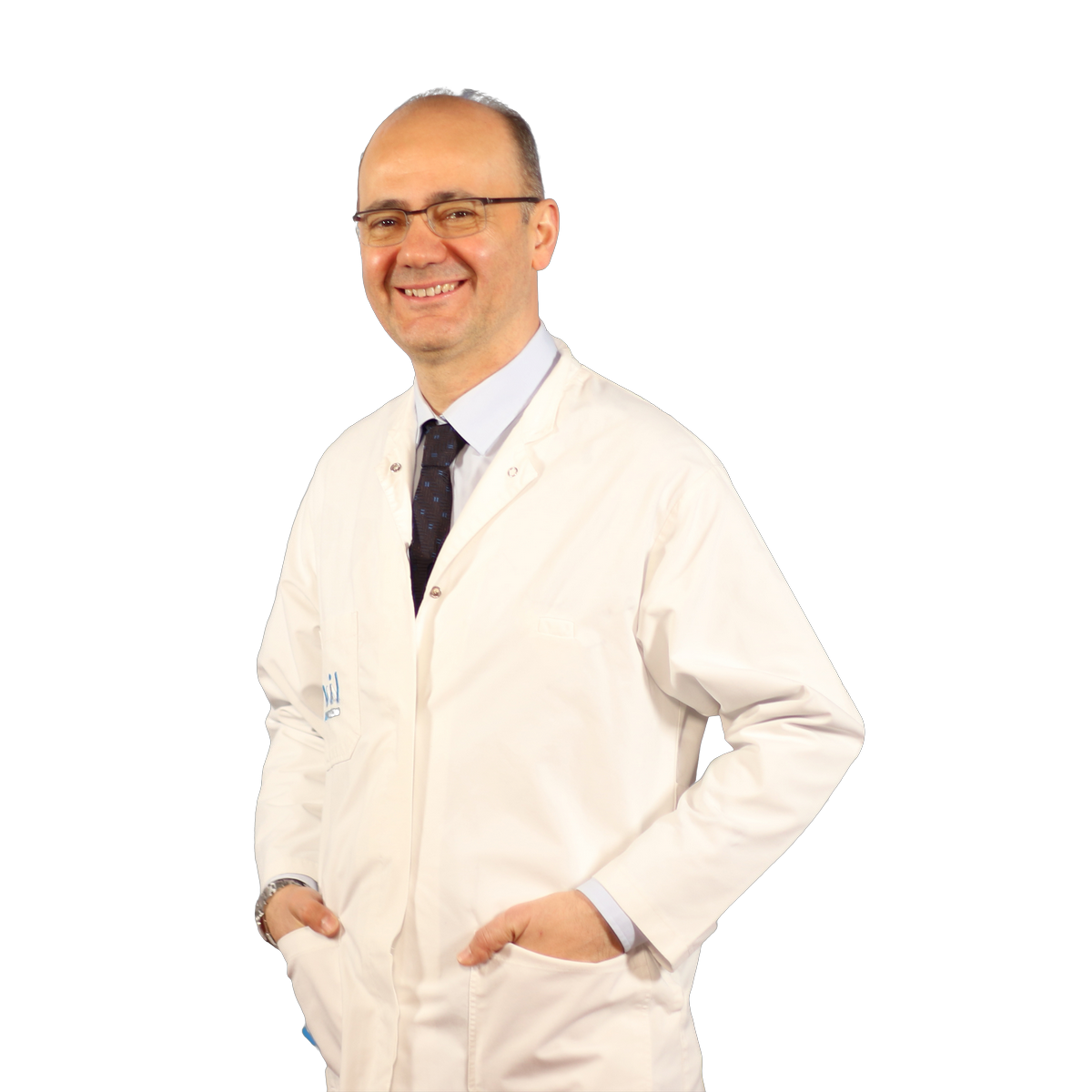
İstanbul Üniversitesi İstanbul Tıp Fakültesi Genel Cerrahi Anabilim Dalı
İstanbul Üniversitesi İstanbul Tıp Fakültesi Genel Cerrahi Anabilim Dalı
Laparoscopic hernia repair with same-day discharge and minimal pain. Inguinal, umbilical, and incisional hernia surgery in Istanbul.
A hernia is the abnormal protrusion of an organ or tissue through a weakness or defect in the surrounding muscular or fascial wall. In the abdomen, the most common sites are the inguinal canal (inguinal hernia), the umbilicus (umbilical hernia), and previous surgical incisions (incisional hernia).
Inguinal hernias account for approximately 75% of all abdominal wall hernias and are far more prevalent in men, owing to the anatomical course of the spermatic cord through the inguinal canal. They are classified as indirect (through the deep inguinal ring, following the spermatic cord) or direct (through Hesselbach's triangle, medial to the inferior epigastric vessels).
A hernia that cannot be manually reduced (incarcerated) or whose blood supply is compromised (strangulated) requires immediate emergency surgery. Symptoms include sudden severe pain, a hard non-reducible lump, nausea, vomiting, and abdominal distension. Go to the emergency department immediately.
All symptomatic hernias require surgical repair. The laparoscopic approach is the preferred technique for bilateral inguinal hernias and for patients with prior lower abdominal surgery that precludes TEP. Open repair (Lichtenstein tension-free mesh repair) remains an excellent option, particularly under local anesthesia.
TEP (Totally Extraperitoneal): The peritoneal cavity is not entered. Access is gained through the extraperitoneal space using balloon dissection, and a large mesh is placed to cover all potential inguinal hernia orifices (direct, indirect, and femoral). TEP is the preferred technique for experienced laparoscopic surgeons.
TAPP (Transabdominal Preperitoneal): The abdominal cavity is entered laparoscopically, and the preperitoneal space is dissected under direct vision. A mesh is placed over the myopectineal orifice and covered with peritoneum. TAPP is preferred for incarcerated hernias and when prior lower abdominal surgery limits TEP access.
The Lichtenstein tension-free mesh repair remains the gold standard open technique for inguinal hernias. A flat polypropylene mesh is sutured over the posterior inguinal wall under local or general anesthesia. It is particularly appropriate for elderly or medically unfit patients for whom general anesthesia carries increased risk.
Open repair is also preferred in the emergency setting (incarcerated or strangulated hernia) and for complex recurrent hernias following prior laparoscopic repair. Prof. Dr. Hakan Yanar performs both open and laparoscopic hernia repair, selecting the optimal approach for each patient.
Prof. Dr. Hakan Yanar performs laparoscopic inguinal and umbilical hernia repair at Liv Hospital Ulus, Beşiktaş, Istanbul. Same-day discharge is the standard for uncomplicated cases. International patients are seen in English, French, and Russian.
Contact Prof. Dr. Hakan Yanar for evaluation and laparoscopic hernia repair in Istanbul.